TalaStar Digital Health UK Ltd · NHS Innovation
WEAN O₂
Wearable Enrichment AI-Enabled Neuro-Adaptive Oxygen Therapy
A nurse-led feasibility study to facilitate efficient post-respiratory illness recovery and improve discharge pathways.
Download Submission PackExecutive Overview
A Closed-Loop Respiratory Governor
WEAN-O₂ is a hybrid respiratory support platform designed to enhance post-respiratory illness recovery through intelligent, closed-loop oxygen and ventilation regulation. It functions as a closed-loop respiratory governor: predicting instability using a patient-specific digital twin, optimising oxygen delivery via breath-synchronised micro-dosing, and applying state-dependent neuromodulation to assist hypoventilation or entrain hyperventilation.
The system aims to stabilise PaO₂/PaCO₂ balance, reduce oxygen dependence, prevent deterioration and readmissions, improve discharge efficiency, and enhance patient independence and quality of life. Post-respiratory illness patients frequently experience delayed oxygen weaning, instability during discharge transition, recurrent admissions, and anxiety-related breathing dysfunction.
System Architecture
Modular Wearable Air Purification System
Five modular components connected in series, each independently replaceable and upgradeable.
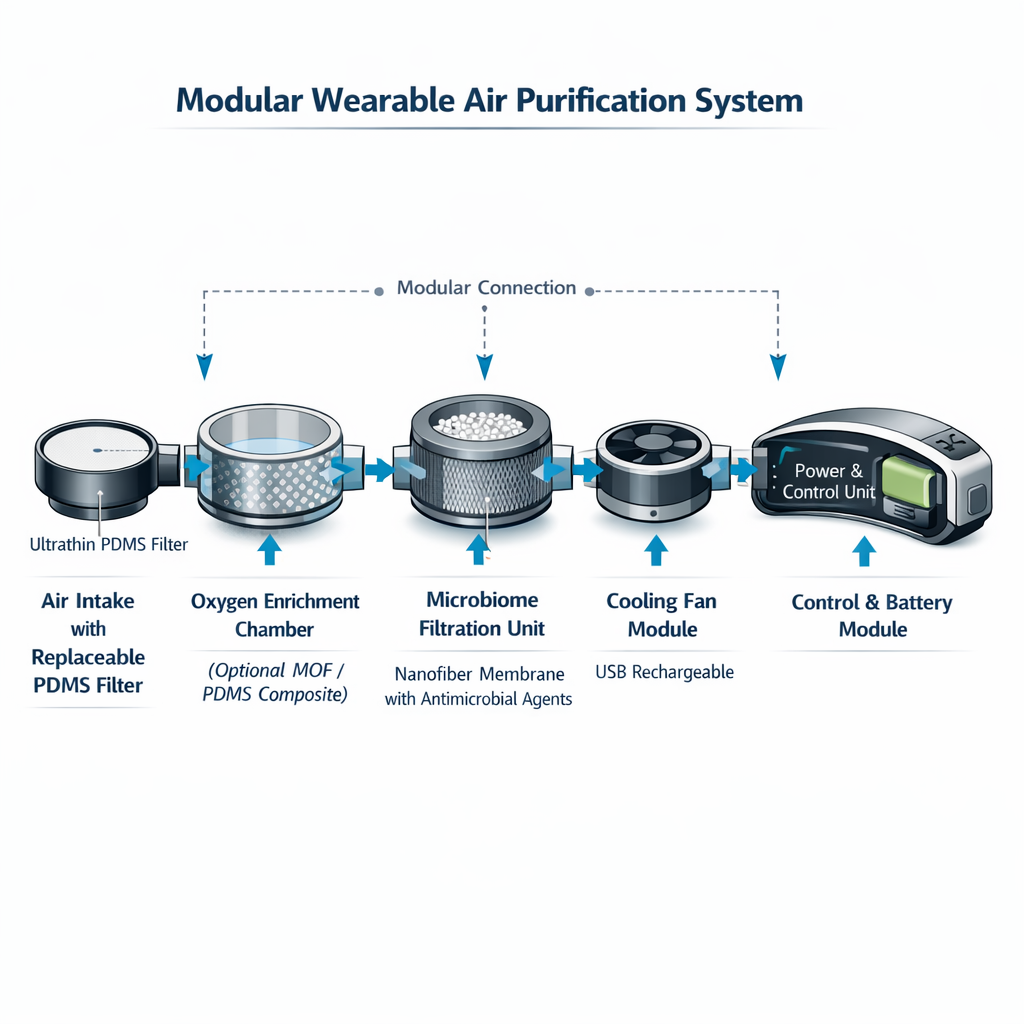
Air Intake
Ultrathin PDMS Filter
Oxygen Enrichment Chamber
Optional MOF / PDMS Composite
Microbiome Filtration Unit
Nanofiber Membrane with Antimicrobial Agents
Cooling Fan Module
USB Rechargeable
Control & Battery Module
Power & Control Unit
Mechanism of Action
Five Integrated Mechanisms
MECHANISM 01
Preventive Detection of Respiratory Instability
Continuous sensing of SpO₂, respiratory rate, effort, heart rate and optional CO₂ detects early pre-decompensation patterns. A patient-specific digital twin forecasts risk of hypoventilation, hyperventilation, and deterioration before clinical thresholds are breached.
Clinical Effect: Earlier intervention, fewer late escalations, and improved stability during oxygen weaning.
MECHANISM 02
Micro-Dosed, Breath-Synchronised Oxygen Optimisation
Controlled oxygen enrichment and inspiratory micro-dosing improve oxygen efficiency per breath. FiO₂ rate limits protect CO₂ retainers and reduce oxygen waste while improving time-in-target SpO₂.
Clinical Effect: Increased time-in-target SpO₂ with reduced oxygen dependency and improved discharge readiness.
MECHANISM 03
Bidirectional Ventilatory Regulation via Neuromodulation
Phrenic stimulation assists hypoventilation by augmenting diaphragmatic contraction, and entrains hyperventilation by stabilising rhythm and reducing chaotic breathing patterns.
Clinical Effect: Stabilised ventilatory control across both ends of the CO₂ spectrum.
MECHANISM 04
Biosecurity and Airway Protection
HEPA and antimicrobial filtration reduce inhaled pathogen load and support resilience during respiratory outbreaks. Filter integrity is monitored through pressure-drop and remaining-life prediction.
Clinical Effect: Reduced infection risk and safer long-term wearable respiratory support.
MECHANISM 05
Safety Kernel and Graceful Degradation
Hard safety limits, signal integrity checks, and safe fallback modes ensure that automation cannot exceed clinician-defined boundaries. The system degrades safely under faults and prompts escalation when required.
Clinical Effect: Minimised risk of harm from automation with preserved human oversight.
The Navier–Stokes Connection
From Pure Mathematics to Life Support
The same equations whose regularity we seek to prove are the equations that govern the oxygen separation process at the heart of WEAN O₂.
Stokes Flow — Bubble Terminal Velocity
When a small gas bubble (radius r) forms at the anode surface, it experiences buoyant force and viscous drag. Using the simplified Stokes formula with a 20% potassium carbonate electrolyte (ρ_l = 1162 kg/m³, ρ_g = 1.42 kg/m³, μ_l = 0.0013 Pa·s) and r = 0.3–0.5 mm, the resulting terminal velocity is approximately 0.175–0.486 m/s.
This implies that for an anode depth of h = 0.05 m, the time required for a bubble to reach the fluid surface is on the order of 0.10–0.28 seconds — enabling rapid, gravity-assisted product self-separation without membranes or external circulation.
Project Timeline
12-Month Research Plan
Imperial Health Charity / NIHR BRC Pre-doctoral Research Fellowship
| Project Phase | M1 | M2 | M3 | M4 | M5 | M6 | M7 | M8 | M9 | M10 | M11 | M12 |
|---|---|---|---|---|---|---|---|---|---|---|---|---|
| Project Setup & Governance | ||||||||||||
| Benchtop Feasibility Testing | ||||||||||||
| System Integration & Simulation | ||||||||||||
| Clinical Usability Evaluation | ||||||||||||
| Data Analysis & Synthesis | ||||||||||||
| Dissemination & Next-Stage Planning |
Technical Profile